 Launch Hair Care Brand in India:
The Indian beauty and personal care market is creating new opportunities for entrepreneurs who want to build their own hair care brands. Consumers are no longer looking only for basic shampoo and conditioner. Hair serums, scalp-care products, hair masks, hair oils, heat protectants, repair treatments, and targeted hair-care formulations are becoming important parts of modern hair-care routines.
For a new brand, this creates an opportunity—but launching a successful hair care range requires more than choosing attractive packaging and putting a product on the market.
You need the right product concept, suitable formulation, reliable manufacturing partner, appropriate packaging, quality testing, regulatory compliance, and a clear brand strategy.
This blog explains how to build a scalp care and hair care brand in India, from selecting products to working with a cosmetic manufacturer, and also explains why it’s important to launch scalp care products with hair care products. This will also help new brands to select hair care products and develop those products without a factory by partnering with the right hair care manufacturing company in India, like Dermtech Research.
Why Scalp Care Is Becoming an Important Part of Hair Care
Scalp care is a methodology in which customers or clients use products that also promote good scalp health. Traditional hair care has mainly focused on the hair itself—cleansing, conditioning, smoothing, and styling.
Scalp care takes a slightly different approach by focusing on products designed specifically for the scalp as part of an overall hair-care routine.
This has encouraged brands to explore products such as:
- Scalp serums
- Scalp oils
- Scalp cleansing products
- Hair-growth-support cosmetic serums
- Anti-dandruff cosmetic products
- Nourishing hair oils
- Lightweight scalp treatments
For entrepreneurs, scalp care can also provide opportunities to create more specialised product ranges instead of competing only in the highly crowded shampoo market.
However, product claims should always match the intended cosmetic use and applicable regulations. Cosmetic products should not be positioned as medicines or used to make unsupported disease-treatment claims. For manufacturing all types of hair care products, Dermtech Research will help startups and established brands by providing samples for your products, testing, stability, development, packaging, and transport services. This means Dermtech Research, a cosmetics manufacturer, will handle everything; startups and established brands just need to focus on their market strategies.
Hair Care vs Scalp Care: What’s the Difference?
Although hair and scalp are connected, they can require different product approaches. Scalp care products can be manufactured by partnering with a scalp care products manufacturer.
Hair care
Hair-care products are generally designed around the appearance, feel, and manageability of the hair. Examples include:
- Shampoo
- Conditioner
- Hair mask
- Hair oil
- Hair serum
- Hair repair products
- Heat protectants
- Colour-protection products
- Hair volumizers
Scalp care
Scalp-focused products are developed around the scalp as part of a complete hair-care routine. Examples include:
- Scalp serums
- Scalp oils
- Scalp cleansing products
- Targeted scalp-care treatments
A strong modern hair-care brand can combine both categories instead of treating them as completely separate markets.
What Hair Care Products Can You Launch?
One of the first decisions for a new brand is deciding which products to launch.
You do not necessarily need 15 or 20 products at the beginning. A focused product range can be easier to manufacture, market, and position.
1. Shampoo
Shampoo is often the starting point for a hair-care range. Shampoo can be manufactured by partnering with a third party shampoo manufacturer, a private label shampoo manufacturer,, and also on contract cosmetics manufacturing.
Depending on the brand’s target market, a company can explore different concepts such as
- Daily-use shampoo
- Moisturising shampoo
- Strengthening shampoo
- Clarifying shampoo
- Anti-dandruff shampoo
- Colour-protection shampoo
- Scalp-focused shampoo
The formulation needs to balance cleansing performance with the desired hair and scalp feel.
2. Conditioner
A conditioner can complement a shampoo and improve the overall customer experience.
Depending on the concept, conditioners may focus on:
- Smoothness
- Detangling
- Conditioning
- Frizz control
- Damaged-looking hair
- Colour-treated hair
3. Hair Serum
Hair serums are popular because they can be positioned as lightweight leave-on products.
Depending on the formulation, they can be developed for purposes such as:
- Frizz management
- Hair smoothness
- Shine
- Hair protection
- Scalp-focused cosmetic care
Hair serums can be manufactured by the private label hair serum manufacturer and third party hair serum manufacturer as well; these manufacturers provide formulations and dermatologist-approved products.
4. Hair Oil
Hair oils remain an important category in the Indian market.
Brands can develop different positioning around nourishing and conditioning hair oils using combinations of oils, botanical ingredients and other cosmetic ingredients appropriate for the intended formulation.
5. Hair Masks
Hair masks provide an opportunity to create a more intensive conditioning step within a hair-care routine.
They can be positioned around:
- Dry-looking hair
- Damaged-looking hair
- Conditioning
- Smoothness
- Hair nourishment
6. Hair Growth-Support Serums
Hair-growth-support products are commercially attractive, but brands need to be careful about claims.
A cosmetic hair serum can be formulated and marketed around cosmetic benefits and scalp/hair-care support. Claims suggesting that a product treats a medical condition or guarantees hair regrowth require appropriate evidence and regulatory consideration.
7. Heat Protectants
Heat styling has created opportunities for leave-in products designed to help protect the hair during styling.
A heat-protection product can complement:
- Hair straightening routines
- Blow-drying
- Curling
- Other heat-styling routines
8. Hair Volumizers and Styling Products
Styling products can help brands build a broader portfolio.
Examples include:
- Hair volumizers
- Styling serums
- Leave-in products
- Anti-frizz products
- Finishing products
Current Hair Care Formulation Trends
A successful brand should not simply copy whatever product is currently popular. The better approach is to understand consumer needs and then develop a formulation that provides a clear product proposition.
Some important directions in modern hair care include:
Scalp-focused formulations
Scalp care is becoming an increasingly important part of complete hair-care routines.
Lightweight leave-in products
Consumers often look for products that provide conditioning or styling benefits without making the hair feel excessively heavy.
Hair repair and bond-care concepts
Products positioned around damaged-looking hair, repair and strengthening are attracting attention in the premium hair-care segment.
Multi-functional products
Products that combine several cosmetic benefits can help simplify hair-care routines.
Ingredient-focused formulations
Consumers increasingly want to understand what goes into their products. This makes transparent communication around formulation ingredients and their cosmetic purpose important.
Personalised hair-care concepts
Different hair types, lifestyles, styling habits and concerns create opportunities for more targeted product development.
The important point for a manufacturer is that a trend should be converted into a technically appropriate product concept, rather than simply added to a label as a marketing term.
How to Choose Products for Your New Brand
Before approaching a manufacturer, define your target customer.
For example, a brand targeting damaged and heat-styled hair might consider:
Shampoo → Conditioner → Hair Mask → Hair Serum → Heat Protectant
A scalp-focused range could consider:
Scalp Shampoo → Scalp Serum → Scalp Oil → Hair Serum
A premium everyday hair-care range could include:
Shampoo → Conditioner → Hair Mask → Hair Oil → Leave-In Serum
This approach helps create a logical product portfolio instead of launching unrelated products.
How Hair Care Products Are Formulated
Cosmetic research and formulation is one of the most important stages in developing a cosmetic product. A safe, unique, and effective product formulation can change everything and boost your entry into the beauty market. There are many cosmetics research and formulation labs that provide innovative formulations as per your ideas and complete hair care development. Dermtech research is one of those that help startups and established brands.
A professional product-development process can broadly follow these steps:
Market requirement → Product concept → Ingredient selection → Prototype formulation → Evaluation → Testing → Stability assessment → Packaging compatibility → Final formulation → Manufacturing
Different products require different formulation strategies.
Shampoo formulation
A shampoo generally needs an appropriate cleansing system along with ingredients that provide the desired texture, conditioning, fragrance, appearance and overall sensory experience.
Conditioner formulation
A conditioner requires a suitable conditioning system to provide the intended slip, softness and manageability.
Hair serum formulation
A serum may require a lightweight vehicle and ingredients selected for the desired sensory and cosmetic performance.
Hair mask formulation
A hair mask typically requires a richer conditioning profile and appropriate texture for application and rinsing.
Scalp serum formulation
Scalp serums require careful consideration of the vehicle, sensory profile, ingredient compatibility and intended application method. scalp serums can be manufactured through choosing the top leading scalp care products manufacturer.
This is why formulation experience matters. A product should not be developed simply by combining a list of trending ingredients.
Private Label vs Custom Hair Care Formulation
When starting a hair-care brand, you may come across two common manufacturing models: private label and custom formulation.
Private Label Hair Care
Private label is suitable for brands that want to select an existing or established formulation and launch it under their own brand.
Potential advantages include:
- Faster product development
- Easier product selection
- Lower formulation-development complexity
- Suitable for startups
- Easier portfolio creation
Dermtech Research is the best third-party and private label hair care manufacturer, which provides complete hair care development services.
Custom Hair Care Formulation
Custom formulation is more suitable when a brand wants a product developed around specific requirements. Your right cosmetic formulation lab partner firstly listens to your requirements and formulates the formulation as per your needs. You must find a trustworthy cosmetic research and formulation lab for hair care product development.
For example:
- A particular texture
- Specific ingredient preferences
- A unique product concept
- Specific sensory characteristics
- A differentiated product position
The right choice depends on your budget, timeline, product concept, and level of differentiation required.
How to Choose a Hair Care Manufacturer in India
After selecting products, now turn to finalizing your manufacturing partner. Choosing the right manufacturer can have a major impact on your brand. Do not select a manufacturer only because it offers the lowest price. There are many qualities and factors that need to be understood while partnering with a manufacturing company/hair care manufacturing company in India.
Consider the following factors:
1. R&D and formulation capability
A manufacturer should be able to understand your product concept and help translate it into a workable formulation.
2. Product range
A manufacturer offering multiple hair-care categories can make it easier to build and expand your portfolio.
3. Quality systems
Ask about manufacturing standards, testing, quality checks, and documentation relevant to your products.
4. Customisation
If your goal is to create a differentiated brand, check whether the manufacturer offers custom formulation and product-development support.
5. Packaging support
Packaging should be considered alongside formulation because product viscosity, dispensing method and packaging compatibility can affect the final product experience.
6. MOQ and scalability
Startups often need manageable minimum order quantities, while established brands need a manufacturer capable of scaling production.
7. Regulatory support
A reliable manufacturing partner should understand the applicable requirements for cosmetic products and support appropriate documentation and labelling processes.
Regulatory Considerations for Hair Care Products in India
Hair-care products sold as cosmetics in India are subject to applicable Indian cosmetic regulations.
The Cosmetics Rules, 2020 are published by India’s Central Drugs Standard Control Organisation (CDSCO), under the Ministry of Health & Family Welfare.
When developing a product, brands should consider:
- Applicable manufacturing requirements
- Product safety
- Ingredient requirements
- Labelling requirements
- Packaging information
- Quality standards
- Appropriate cosmetic claims
- Required testing and documentation
The regulatory position can vary depending on the type of product, ingredients and claims being made. Therefore, regulatory review should be part of product development rather than something considered only after manufacturing.
For current requirements, manufacturers and brands should refer to the applicable CDSCO rules and official updates rather than relying on outdated blog articles.
Packaging and Branding Considerations
A good formulation still needs appropriate packaging.
For example, packaging decisions may depend on:
- Product viscosity
- Dispensing method
- Product usage
- Formula compatibility
- Stability
- Target price
- Brand positioning
A premium scalp serum may work well with a dropper or specialized dispenser, while a family shampoo may be more appropriate in a larger pump or flip-top bottle.
Your packaging should also communicate the brand’s positioning clearly.
How Dermtech Research hair care manufacturing company in India Can Help Launch Your Hair Care Brand
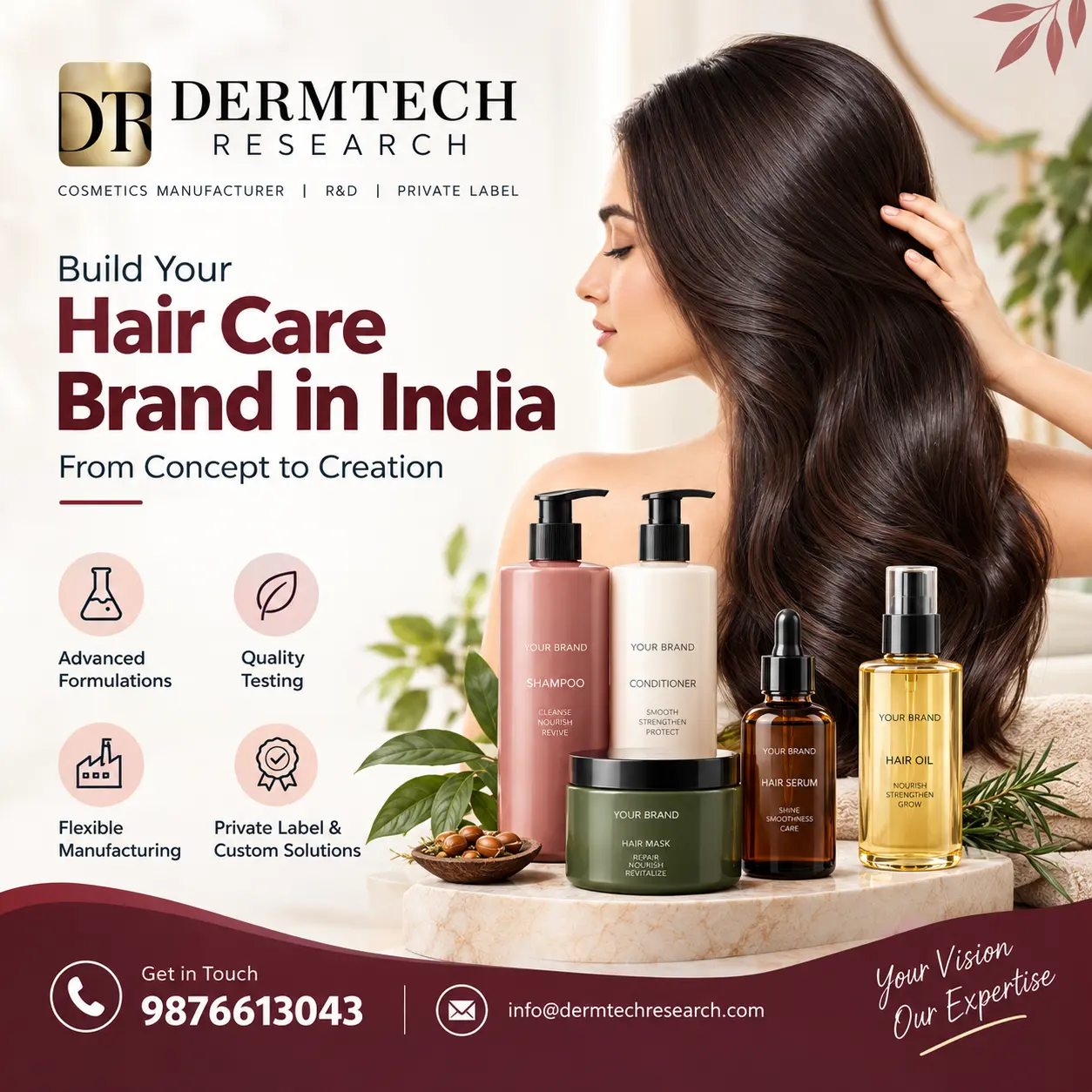
Dermtech Research is a leading third-party cosmetics manufacturer in India, working with established brands and startups to develop and launch a wide range of beauty and personal care products. With its dedicated R&D laboratory and modern formulation facilities, Dermtech Research supports brands from product concept and formulation development to testing and manufacturing. The company conducts stability, quality, and efficacy evaluations, as applicable, to help ensure formulations meet their intended requirements. Dermtech Research provides private-label and customized manufacturing solutions, making it easier for businesses to turn their hair-care ideas into market-ready products.
Dermtech Research works with brands looking to develop and manufacture hair-care products, including categories such as
- Shampoo
- Conditioner
- Hair oil
- Hair serum
- Hair-growth-support serum
- Hair masks
- Heat protectants
- Hair volumizers
- Colour-protection products
- Scalp-care products
- Styling products
Depending on the project, brands can explore private label or customised product development.
The goal should not simply be to manufacture a product. It should be to develop a consistent product range that fits the brand’s target customer, positioning, and long-term growth strategy.
Contact Details:
Phone: +919876613043
Email:- info@dermtechresearch@gmail.com
Address: Ground Floor, TDS Tower, 006, E-193, Phase 8B, Sector 74, Sahibzada Ajit Singh Nagar, Punjab 160055
website: https://dermtechresearch.com/
A Simple Roadmap to Launch Your Hair Care Brand
If you are starting from scratch, follow this basic roadmap:
Step 1: Define your target customer
Identify who you want to serve and what type of hair-care routine or cosmetic concern your products will address.
Step 2: Select your initial products
Start with a focused range rather than trying to launch everything at once.
Step 3: Decide between private label and custom formulation
Choose based on your differentiation requirements, budget and timeline.
Step 4: Finalise formulations
Work with your manufacturer to evaluate prototypes and select the final formulations.
Step 5: Select packaging
Choose packaging based on the formula, product positioning and customer experience.
Step 6: Complete testing and documentation
Make sure the required quality, safety and regulatory considerations are addressed.
Step 7: Develop your branding
Create your brand identity, labels, packaging design and product communication.
Step 8: Manufacture your products
Once the formulation, packaging and documentation are finalised, move to production.
Step 9: Launch and collect customer feedback
Your first launch should also be a learning stage. Customer feedback can help determine which products should be improved, expanded or added to the range.
Final Thoughts
The opportunity in hair care is no longer limited to shampoo and conditioner.
A modern Indian hair-care brand can build a complete portfolio around cleansing, conditioning, scalp care, hair treatment, repair, protection, and styling.
However, successful product development requires more than following trends. The formulation, ingredients, packaging, claims, quality requirements, and manufacturing process all need to work together.
For entrepreneurs, working with an experienced private label or custom hair care manufacturer in India can simplify the journey from product concept to finished product.
Dermtech Research can support brands looking to develop a focused hair-care portfolio through product development and cosmetic manufacturing solutions. This company does not work only with startups, and serving many established brands.
Ready to develop your own hair-care or scalp-care range? Contact Dermtech Research to discuss your product concept, formulation requirements, and manufacturing needs.
Frequently Asked Questions
1. Can I start a hair-care brand without owning a factory?
Yes. A brand can work with a private-label or third-party cosmetic manufacturer to develop and manufacture its products without establishing its own manufacturing facility.
2. What hair-care products should a new brand launch first?
There is no universal combination. Shampoo, conditioner, hair serum, hair oil and hair masks can form a starting range, while scalp serums and specialised treatments can be added depending on the brand’s positioning.
3. What is the difference between private label and custom formulation?
Private label generally involves selecting an existing formulation and branding it for your business. Custom formulation involves developing a product around specific brand or formulation requirements.
4. Can I create my own hair serum formulation?
Yes. Depending on the manufacturer and project requirements, brands can explore custom hair serum development with specific product concepts, textures and cosmetic ingredients.
5. How do I choose a hair-care manufacturer in India?
Evaluate the manufacturer’s formulation capabilities, quality systems, product range, MOQ, customisation options, packaging support, regulatory understanding and ability to scale with your brand.
6. Can I launch scalp-care products under a hair-care brand?
Yes. Scalp-care products can be incorporated into a broader hair-care portfolio, provided the products and their claims comply with applicable cosmetic requirements.
7. How long does it take to develop a hair-care product?
The timeline depends on whether you choose an existing private-label formulation or require custom development, as well as formulation iterations, testing, packaging, and other project requirements.